Showing posts with label Alaska. Show all posts

Saturday, July 28, 2012

The Grizzly Bears of Lake Clark


 I spent the second week of July at the Silver Salmon Creek Lodge, one of the most extraordinary places on earth. It is located on 40 acres of private land within the boundaries of Lake Clark National Park in Alaska. This park was established in 1980 and the only access is by small plane. The facility has a main building where the most important place is located- the dining room. You will be served family-style wholesome and abundant meals- not to mention the deserts. They ring a bell to call for the feasts; so far the bears have not learned the meaning of that sound. There are several cabins spread nearby. It is not unusual to see bears walking around the buildings. For more information go to: http://www.silversalmoncreek.com/


The routine in the camp was to go out around 0600, returning for breakfast by 0800 and then out in the field again till lunch time.  After lunch we usually returned to our cabin for rest or to edit images while others opted to go fishing.  Then, we went out again at 1600, returning for dinner at 1900.  After dinner we went out again until sunset.  The early morning and late afternoon offered the best lighting conditions.


Imagine photographing dozens of grizzly bears, huge animals with a reputation for being aggressive, on foot at close range- not a single act of unfriendliness, rather one of total ignorance of our presence.  They were so close that a 400 mm lens was too tight for photographing most of the time; so I would have to back up in order to frame the whole animal within the viewfinder.  This also provided a way to maintain a safe distance from the bears.  Another item that may have helped our safety is that we were a group of 6 and always maintained a close group perhaps making us looks bigger.  These bears may be acclimatized to the presence of people that visit the area.


The first day after dinner we ran into Pavlov, a grizzly bear so named because of his strange personality.  It appears that this bear enjoyed posing for photographers and would lie down in the sand, roll around and demonstrate strange poses.  Then he would run to the water, run, come back to the beach, shake the water and start another routine.


There was a pair of 2-3 years old cubs that were recently chased away by the mother and were beginning to start their independent lives.  On various occasions they were chased by their mother or other adult bears and they would run away as fast as they could; on occasion they would climb a nearby tree. 

 
There was a pair of 2-3 years old cubs that were recently chased away by the mother and were beginning to start their independent lives.  On various occasions they were chased by their mother or other adult bears and they would run away as fast as they could; on occasion they would climb a nearby tree. 


The bears live in this area because of the abundance of food and consequently grow larger than the inland grizzly bears.  They have an ample supply of grass which they spend most of the time eating just like a cow, are experts and digging and opening razor clams in the mud flats at low tide (one bear cut the lip with the shell, maybe that is why they called razor clams), and later on in August-September fill their bellies with the salmon that come up Silver Salmon Creek to lay their eggs.  They are also scavengers and one evening, one found a dead skate that provided an opportune dinner.


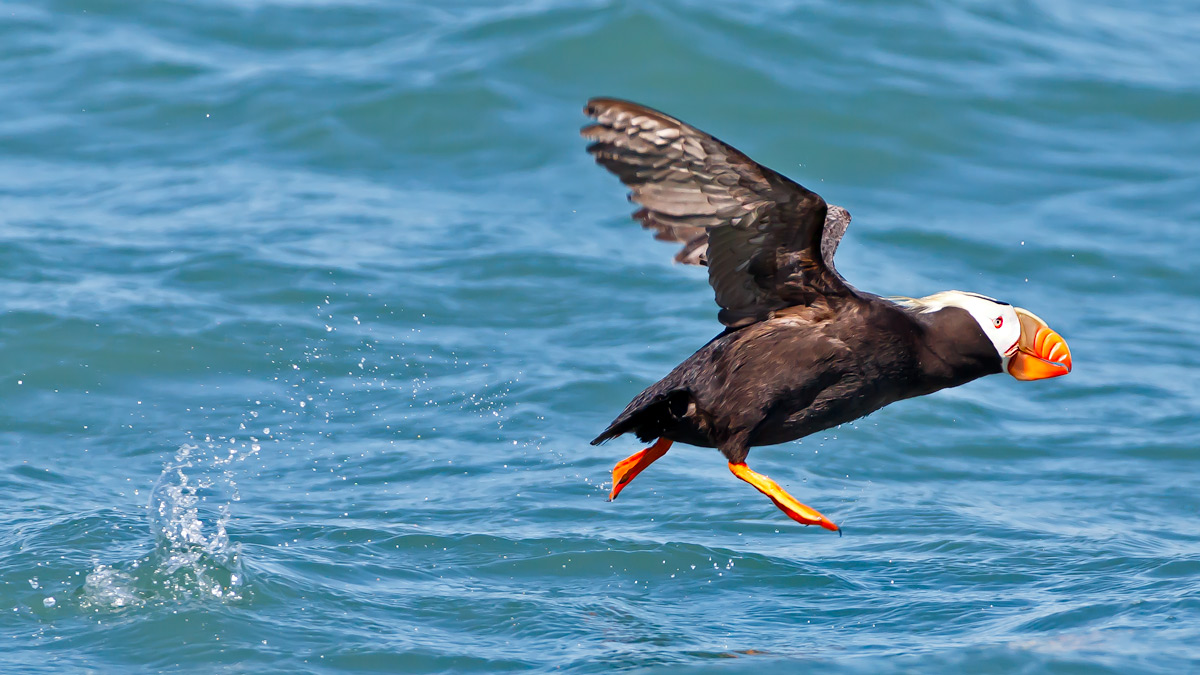
There are other mammals and birds in the area such as wolves (saw tracks on the sand), beavers and numerous shore birds such as yellow legs, tufted puffins and mew gulls.  But next to the bears, the most exciting were the bald eagles. 


This one of the places on earth where I like to return, just as East Africa and Patagonia and enjoy a back scratch while waiting for another grizzly to walk by.


Saturday, October 9, 2010

Denali, Day and Night

Both of the images are High Dynamic Range (HDR) that represents most of the visible world, therefore some what you see may be bit unnatural. I did the HDR using Photomatix 3 Pro. Then I opened them in Photoshop CS5, cropped them, applied curves to correct colors and finally sharpening. The above image was taken at Wonder Lake, near Mile 85 of the Denali Park Road. While I was there taking the images, another photographer stopped to tell how lucky I was; he has been coming here for the last 27 years and never seen Mount McKinley so clear, not a cloud in the sky. Maybe I was lucky twice; I also won the Denali Lotto which permits winners to drive their own vehicles for a day inside the park beyond Milepost 15. This is allowed once a year at the end of the season for about 4 days. Other than on this occasion, one has to ride a bus past the gate at Milepost 15 at the Savage River Bridge. Due to the restrictions of the blog, I was unable to properly size the images but if you click on them, a larger image may be available depending in your settings.

What you see above are the Northern Lights or Aurora Borealis taken near Denali. This image is also HDR but with a different twist. When using HDR, one changes the exposures to obtain more detail of the dark and light areas of an image. In this case, I did not change the exposures but I rather used time intervals to capture the changes in the lights, as they expanded and contracted across the sky. This technique may be called stacking by some. Since I could not cover the lights across the sky using a 16-35 mm lens set a 16 mm, I used another secret trick of mine (well not secret any more after you read this). I just set the camera in the tripod with the lower left corner and the upper right corners of the viewing frame aligned with the horizon. So I am really splitting the frame with an imaginative diagonal line and aligning that line with the horizon, then I crop a bit the ends to make image rectangular. The University of Alaska has a website that predicts the probability of seen the northern lights (http://www.gedds.alaska.edu/auroraforecast/) and I relied on it to wake up in the middle of the night and search for them. It worked for the night when this image was taken. While at ANWAR, where the photos of the bears of the previous blog were taken, this site showed very poor probabilities of seen them so to bed I went. When I woke up the next morning, the first thing the guide tells me is about the extraordinary northen lights seen that night. These were in the form of waving colorful curtains that cover most of the sky. So when I asked him why he did not wake me up, he responded : "You told me that you came to see Polar bears."

Monday, October 4, 2010

Polar Bears

After traveling more than 10,000 miles by land, air and sea, I am back in Virginia after meeting with Polar Bears in the Alaska National Wildlife Arctic Refuge (ANWAR). They are the ultimate predators and being close to them with not protection, other than a guide with a weapon was unnerving. Although I have been in the proximity of lions, elephants, rhinos and leopards in Africa, there I was sheltered by a vehicle that could speed away from danger. In ANWAR, I was on foot on land with no chance to outrun the bears, they can do 30 miles per hour; more than than the 5 that I can achieve over a short distance. The outcome is obvious.

I saw about twenty bears, with several females having 2 cubs each, do not know is that is the usual number. On one occasion, one family approached in an inquisitive manner since I am still here; if the mom who have wanted to provide the cubs with a dinner, I would not be here writing this blog.

One of the cubs was extremely curious and came within 20 feet and performed by standing in its feet and moving the arms as umpire signaling in a football game. Another found a white feather, which it examined closer and then started playing with it.

While searching of the bears in a small boat, ran into two bears swimming and was able to photograph them. They showed not interest and continue on their way. These animals are large and can swim hundreds of miles, one raised its body about 3 feet above the water to look around. I am quite sure that if they wanted, they could have come aboard the boat or turned it over and get meals inside. I had been many places with wild animals, but no where with the level or risk or excitement that I had here.


Friday, January 1, 2010

The Digital Decade

As the first decade of the XXI Century ends it is time to reflect what it brought to my photography world. The most obvious is the rise of digital photography earlier in the decade; it is the most radical advance in the history of capturing images. This technical advance allowed for almost anyone to become and instant photographer. Being at the right place, at the right time can make anyone take a professional photograph. It has made me a worst photographer, now I indiscriminately shoot anything without paying close attention to composition, exposures or subject matters. I have Photoshop to crop, correct exposures and enhance the images when I get home...this was not that easy or cheap in the age of film. And what happened to all my film slides of the previous century? Earlier in the decade I used to scan a lot of them but soon I stopped. Now they just seat in boxes fading away but provide me an excuse to revisit old place to get digital images.

Birds is what brought me into photography originally and has taken me to various corners of the world. Travel expanded my horizons into other types of photography such as landscapes, buildings and people. No doubt birds are still my main focus as shown above photo of a cusinga in Costa Rica.

This image of a bald eagle was taken in Homer, Alaska in 2008. There was a wonderful lady there that used to feed the eagles in the winter and photographers from all over the world, congregated there in the winter to capture images of the wonderful birds. I was privileged to meet this lady, who allowed me into her private world by assisting her in the defrosting and cutting of the fish to feed the eagles. I had bought some booths that protected the feet to -32 F temperatures; they did not work for me. So to the local sports supply store I went and bought some knee high booths with 1 inch thick inner liners. These were supposed to protect my feet to -78 F temperatures...but I still had cold feet.

Birds are the most challenging to photograph, particularly white ones. The snowy egret was photographed in Huntington State Park in South Carolina. This is a not widely known place in the bird's lovers world. I had visited here since the early 70's and at that time the park was not well developed or often visited but wildlife seems more numerous and easily approachable now.

The quetzal above is a bird that I first started chasing in 1975 in Central America, and finally got
the opportunity one day in Costa Rica in 2007 to be see one morning. Unfortunately it was a foggy morning but the joy of seen 8 quetzals on a single tree was elating.
The Civil War is still going on the the Southern States and living in Virginia, photographing these events has become a late habit. The participants are really re-living those times and their clothes, weapons and camps are close reproductions of those of the past war. Even in their language they sound archaic. The expense of their outfits I am sure triple or quadruple the value of my photographic equipment.

During the last decade I visited more countries than my previous 3 decades of travel. Of these countries, Mongolia remains the most vivid in my mind. I had never been so cold and hungry in any of my previous travels, nor in such and adverse environment as it was in the Gobi desert. Even in Africa, all the amenities of life are available while camping in the bush. Here, electricity was randomly available, drinking water scarce and food was spartan. But it was worth it, the Mongolian people are the most hospitable and friendly as well as colorfully dressed. I never had interest in horses previous to my encounter with the Mongolian horses in the Gobi. On a freezing morning I was photographing a camel caravan with the sun behind my back. For whatever reason I turned back, and a stallion with his harem was coming down one of the sand dunes. A sight of a lifetime, not planned, I was there at the right place at the right time and happened to find myself with images and memories to cherish in the XXI century.

Russia was a new country to me the last decade. What a fabulous place with such a tumultuous history. My perception of history has changed several times as I visited countries such as Egypt, Italy, China Mexico and Peru due to their ancient civilizations. Imperial Russia was something unexpected, its wealth are so powerfully expressed in its churches and palaces; this is not matched by those in the empires western Europe. Previous to visiting here, I thought that Paris was the first City in the World, now I have conflict as to if it really Saint Petersburg, even thought I was assaulted and robbed there.

The highlands of Guatemala is one of those places in the world that are unique for me. The descendants of the Mayas that live there are very creative and have a way with colors in their clothing, potteries and jewelry. And this is enhanced by the mountains and forest in the area. And there is Lake Atitlan, there is no place in the world with such richness of contrasts among the clothing worn by the of the Indians living in the various villages around the Lake. You can tell where they are from by their outfits, unfortunately this habit is disappearing although still mostly preserved by the women, most men dress now Western style. I first visited Lake Atitlan in 1975 when it was still a very isolated area, not tourist hotels, no waterfront street full of restaurants and no water pollution. I was lucky to see then the Atitlan Grebe, now considered extinct as well as my first fresh water crabs; how did they get there?

Sarajevo was another of those shocking experiences of my photographic encounters of the last decade. Here for the first time I had seen a modern city destroyed by a recent civil war. Beautiful abandoned buildings just full of cannon and bullet holes, the scars of tribal wars. Some places seem to be cursed by history, the First World War started when the Archduke Ferdinand of Austria was assassinated here. The spot where this happened is now a mandatory tourist spot with the proper museum nearby to remind us of the curses that the political struggles impose in their societies.

As the second decade of the XXI rises who knows what fish we will catch but as they say, the early bird catch the early worm, so I will be hitting the road again looking for whatever subject happens to catch my eye. As more photo equipment comes into the market, I will be debating
what to get and what to get rid off. One thing for sure, the more lasting value in the photo equipment are in the lenses, the camera bodies and computer hardware/software follows Moore's Law and becomes obsolete in 18 months. But it seems that for digital camera bodies, the obsoleteness is being compresses to about 12 months.

So come and visit sometimes and see what images are coming around the corner this second decade. Will enjoy hearing from you, so comments are welcomed. Happy new Decade!!!

Wednesday, February 18, 2009

The Eagle Lady

In 2008 I had the honor of being welcomed to the home of Jean Keene, The Eagle Lady of Homer, Alaska. I spent about a week there with my friends Ken Conger, David Tuttle and Jerry Pellett. The daily routine consisted of of being at Jean's backyard from 7 AM to about 11 AM to photograph the feeding of bald eagles by Jean helped by her friends and visiting photographers. There is no other place where you can get "eye-to-eye" with and closely photograph these magnificent birds. Jean passed on in January of this year and the feeding of the eagles will probably cease March 25, 2009. She had been feeding the eagles for December to March for more than 30 years. Her feeding of the eagles was going to cease anyway do to pressures from local government and wildlife officials. She took also took care of injured, and while we were there, she just grabbed one with an infected eye and sent it to the rehabilitation center in Anchorage.. It seems that she knew all the eagles and they were not afraid of her. While there, we had the pleasure of taking Jean on her birthday to dinner at her favorite place, the Lands End Restaurant, where she was a regular customer. To our delight, she consumed her favorite drink and a steak while we listened about her eagle stories.
Jean's backyard was the meeting place of "Who's Who" in the world of wildlife photographers. It is likely that most of the incredible photos of bald eagles you see published were taken on her backyard. jean go me my "15 Minutes of Fame" when I received recognition from the National Geographic Society International Nature Photography competition for 2008 for an image of bald eagles in aerial combat over a fish taken from her backyard. This image is to the right. I considered returning to Homer this year, but it would not be the same with Jean.