Saturday, September 3, 2011

The Jaguars of Pantanal, Brazil

 Just returned from one of my "one in a lifetime" adventures; I was dreaming at least to photograph just one jaguar.  It was surpassed, in 8 days sighted 23 of these cats.  My first encounter was with a jaguar resting on bluff next to the Cuiaba River hidden by the underbrush (above).
 The next day, I saw a jaguar shaking a small tree and could not figure why? Then, I realized that it was knocking young flightless birds from their nests.  These were baby limpkins, and as they dropped from the tree, fell into the water and were able to swim ashore.  The leopard walked down to the river's edge, picked one chick, eat it and so on.   


 After feasting the jaguar walked up the bluff and along the shore to a sandy beach to get a drink, it paused, looked around and continued drinking.  Then went to take a siesta.
On another occasion, I witnessed a fight between two males; they appeared to be siblings just playing.  But the next day in the same area, there were 4 males and one female.  It became clear to me that the fight that I saw the previous day was not a game; they were fighting for the privilege to visit with the girl.  By this time, the scores were settled and prevailing male was mating with the "she jaguar".

One day I followed a jaguar along the shores of the river from a boat while he hunted for capybaras.  These giant rodents are very alert and can swim and dive swiftly.  He saw a family of capybaras with a young one.  As he paused, somehow the male capybara became aware of his presence, gave a sharp call to which the mom and baby responded by jumping from about 20 feet in height into the river.  The male followed soon after.

Sunday, August 7, 2011

Yellowstone Park continued...


Spring time brings courtships and new life to Yellowstone.  I had the opportunity to observe a pair of Barrow's goldeneyes going through their romance.  They got so close to me that in my opinion, they were obsessed with their love making that they did not see me.  Part of the ritual was for the male to take short runs and then approach the gal, accompanied by lots of head movements.

After mating, the female climbed into a log and preened herself insuring that all feathers were in place and flew to a large pine tree where it appears that a nest was being built.

A mama badger was busy feeding her family of 3 young ones.  I spent time with the family until finally; I was able to capture the Mom bringing a Uinta ground squirrel to the den.  Prey was not easy to catch because the mother will be gone at times for 3-4 hours before returning, and some times with no prey.  This was my first time ever seen badgers in the field.

Brown bears are easily seen in the Park but at times 1 or 2 days go by without seen one.  But other days many are sighted at close range.  On one day I saw 12 brown bears.  Grizzly bears are also seen but I was not able to get a good image of one.  In the spring time is common baby bears.  Whenever bears are seen, lots of people arrive along with the park rangers; these are preventing the tourists for getting close to the bears and to get the traffic moving.


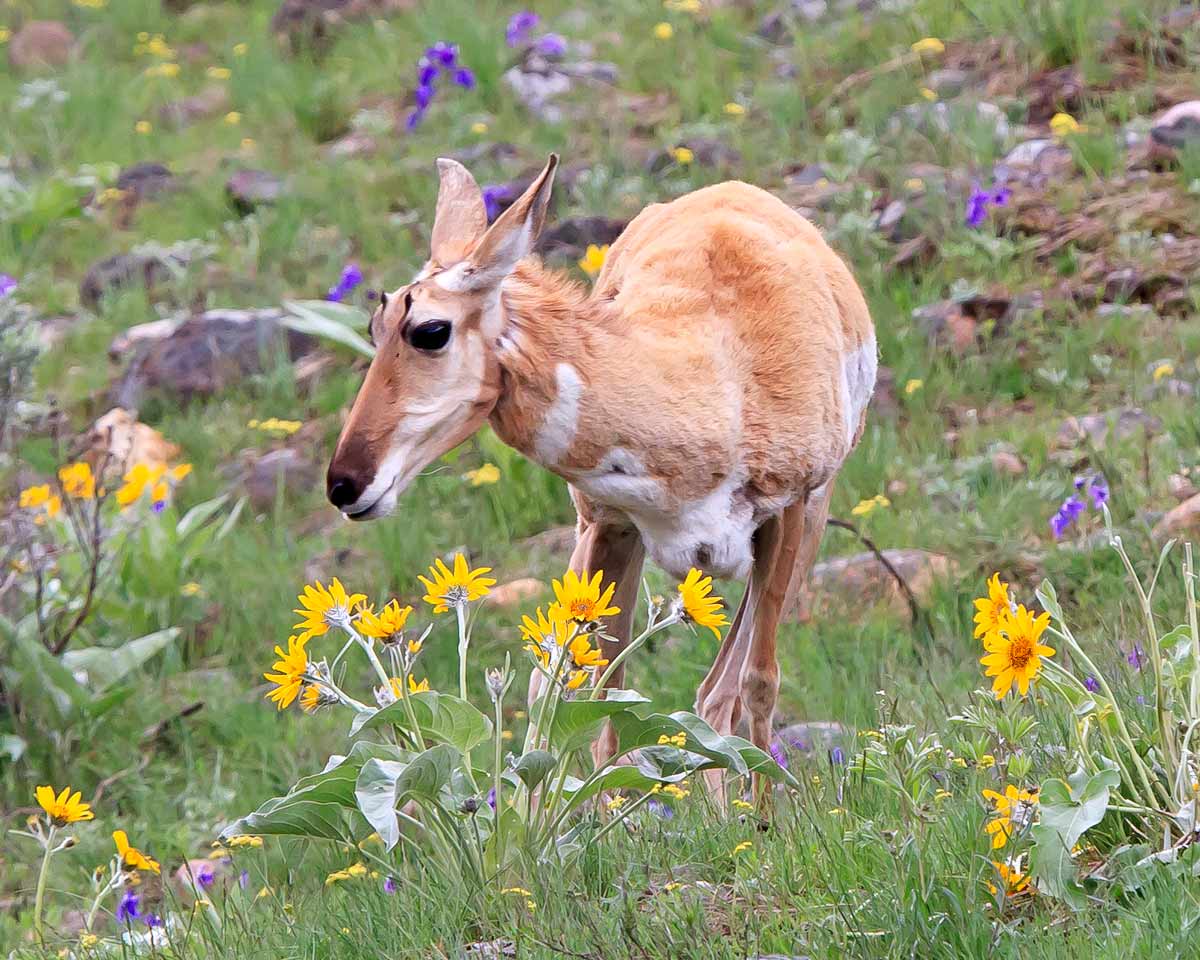
Elks and buffaloes are very common as well as pronghorn antelopes.  Most the mothers are feeding the young ones.  These, like young children are running around, jumping and tasting the grasses, the joy of new life.

Late one evening I ran into a female moose with cute yellow calf.  She was looking for a safe place for the calf to bed for the night.  She was at the edge of the forest looking along the tall grass, when she found the right spot, the calf when down.  I am told that the calf will not leave the spot until sunrise.

Saturday, July 30, 2011

Wyoming's Serengeti


Yellowstone has many similarities to the Serengeti/Masai Mara ecosystems due to the large concentration of ungulates and their migrations patterns.  Although the number of migrants in Yellowstone is smaller, it is still a sight to enjoy.  The rainy and dry seasons, drive the migrations in East Africa; while in Yellowstone, the temperature changes between winter and summer are the forces that cause the migrations.  Above we have some buffaloes jumping a tributary of the Yellowstone River; you will see wildebeests jumping the Mara River in Kenya but in larger numbers.  


Due to the large numbers of visitors in both Yellowstone and East Africa, ways of controlling their impact in the ecosystems are very similar.  In Yellowstone, vehicular traffic is limited to the roads; this is a practice adopted in the recent past in the Seregenti, and to a more limited extends in the Masai Mara.  Off the road driving is not longer the rule in Africa.  Another phenomenon is the concentration of people/vehicles where an unusual animal sight is found or where a kill have occurred.


The lions of Yellowstone are the wolves and their cousins the coyotes.  There are also  bears as well as smaller ones as the badgers.  The wolves were recently reintroduced in the park and their presence has attracted a loyal group of trackers that spent endless hours recording their behavior.


I had visited this park in all seasons except for the winter; I do not handle cold temperatures well. Spring is probably the most exciting because of all the new life as well as the flowers abundantly present.  Of course, fall is also colorful because of the changes in foliage and the elks rutting season.  Summer…it is for the tourists.  Yellowstone is the Premier Park in the USA; there are animals, unusual landscapes to include geysers and waterfalls.  A place of wonders.  


Sunday, July 17, 2011

Camas National Wildlife Refuge


Driving north in Idaho I-15 towards the refuge, I saw this large six-pack that I could not pass.  Unfortunately they were silos camouflaged as beer cans; a refreshing sight after driving for hours.  This area of Idaho is mostly agricultural and yes, they do grow potatoes there.


Arriving late in the afternoon at the Refuge, it did not look too impressive, and as much of the West bodies of water this spring it was flooded.  It was established in 1937 as a breeding ground for waterfowl and as a resting stop for migrating birds.  My first sighting was the yellow-headed blackbirds, a new species for me.  They were all over the cat tail reeds displaying and raising a cacophony of sounds.  It was the breeding season and the males were trying to impress the girls and defending their territories.  In their behavior, they are very similar to their cousins the red-winged blackbirds.


The waterfowl were courting and some were already building their nests.  Others such as the coots had already hatched their chicks and were actively feeding them.  The cinnamon teals above, were also a new species for me, the males color could have not been better described; just the same color as the condiment.  The females, more practical, had a plumage that help them to blend with the reeds where them nest.

Another surprise for me were the male ruddy ducks, I had never seen them before in their breeding colors with those strong red feathers and the fabulous blue bills.  They are really funny to watch they pump their heads up and down when attracting the females.  Another peculiarity is that they make the water bubble in front of their chests by making a very low frequency sound (I assume since I could not hear any noise).   I have seen the similar bubbling of water done by alligators.  These small ducks are very aggressive and will not permit another male of any species to even look at their partner.   Jealous birds they are, wonder why?  The females are just plain Jane's, but then, I have no ruddy duck eyes.

The long billed wren was also very active settling territorial disputes and chanting to the world "do not trespass.  This bird I photographed earlier in the year in the east coast while involved in the same behavior.  It a fetish little bird.

Harriers were also very active flying over the marshes looking for prey.  These were already nesting among the reeds.  One evening, a male have caught a rodent (above) and flew towards its nest; on approach the female flew up from the nest and let go of the furry creature that was promptly captured in mid-air by the female.
Visiting Camas was very rewarding; at one time it was a farming area.  Some of the ruins of the original settlers are still visible, against the chocolate flood waters and the blue skies make a good departure image.

Sunday, July 3, 2011

Above Clouds in Mount Evans

 
Mount Evans in Colorado, is the highest mountain in the USA whose peak that can be reached by road. Early in June, I drove up several times to the top at 14,150 feet to photograph the mountain goats and the Bighorn Sheep.  The first morning I suffered a slight case of altitude sickness but later on there were no further symptoms.  The weather was variable with complete cloud cover at times, strong winds and freezing point temperatures at the top.
The goats are easily approached or rather; they approach you at the Great House, the ruins at the peak.  It was a resort built in the 1930's that was destroyed in 1979; some said by fire, others by an explosion of a propane tank while it was refilled.

The goats were seen the first day at sunset and the next morning at sunrise, the sheep were never seen.  These are wild animals that are hunted during the fall, yet for some reason, they know that a certain times of the year humans are safe.

They come to the Great House to lick the salt applied to the sidewalks to melt the ice/snow, to prevent the two-legged animals from slipping and falling. While licking the salt, the goats are totally oblivious of people and they will come within arm reach. 
The mountain goats travel in families and my goal was to photograph newly born ones. But they were not brought to the Great House while I was there. Perhaps they were not born yet since this year had very long winter.  I found a similar situation with other species where new born were rarely seen during my 4,000 miles trip throughout the West that followed.

There are a few other animals to be seen just as the marmot above and an occasional raven at this time of the year.  At the lower attitudes mule deer and various smaller birds were seen, and at the entry to the park, hummingbirds were visiting the feeders.
 
The road to the top was spectacular but not as dangerous as those I have driven in Central and South America.  Two scenic stops come to mind, Echo Lake where several snow boarders were practicing their skills and the interpretative center near the Sequoia trees forest.  Some of the trees nearby are more than 2000 years old and they showed it.  The harsh weather sculptured the trees into very twisted and scared shapes.  These are a delight to photograph as the sun illuminates them at sunrise or sunset.

Saturday, June 4, 2011

15th Annual Mattaponi Pow Wow


During the Memorial Weekend, I went to the Mattaponi Indian Pow Wow in King William County, Virginia.  The tribe was one of the six under Chief Powhatan, father of the famous Pocahontas, who married one of the Captain John Smith's officers.  The latter founded Jamestown, the first English colony near present Williamsburg.


The event started with a parade followed by a speech by the Chief, drumming, dances and exhibits regarding the Mattaponi culture.  This is the first Native American celebration that I have attended.  Their friendship and well as their food was outstanding.  I had the best "corn on the cob" ever!!!


I found photographing the event challenging.  There was a circle within which all the events took place, providing a difficult background.  Nevertheless, the images of the dancers and their attires were captured with beautiful vivid colors.


The Mattaponi have a long history of struggle in preserving their culture and lands from the English colonials as well as the Americans after the War of Independence.  During their various treaties, they were attacked during the Bacon Rebellion and the Iroquois wars.


Their official recognition as a tribe as well as ownership of their lands has been challenged since the arrival of the British but they were able to preserve them.  Thomas Jefferson defended their lands from encroachment while he was governor of Virginia.  The tribe has been recognized by the government of Virginia and has their own government.


The name of the tribe comes from the Mattaponi River, whose name was derived from the confluence of the Ma, Ta, Po and Ni rivers.  It flows into the York River. For a more regarding the Pow Wows, go to: http://virginiaindians.pwnet.org/today/pow_wows.php