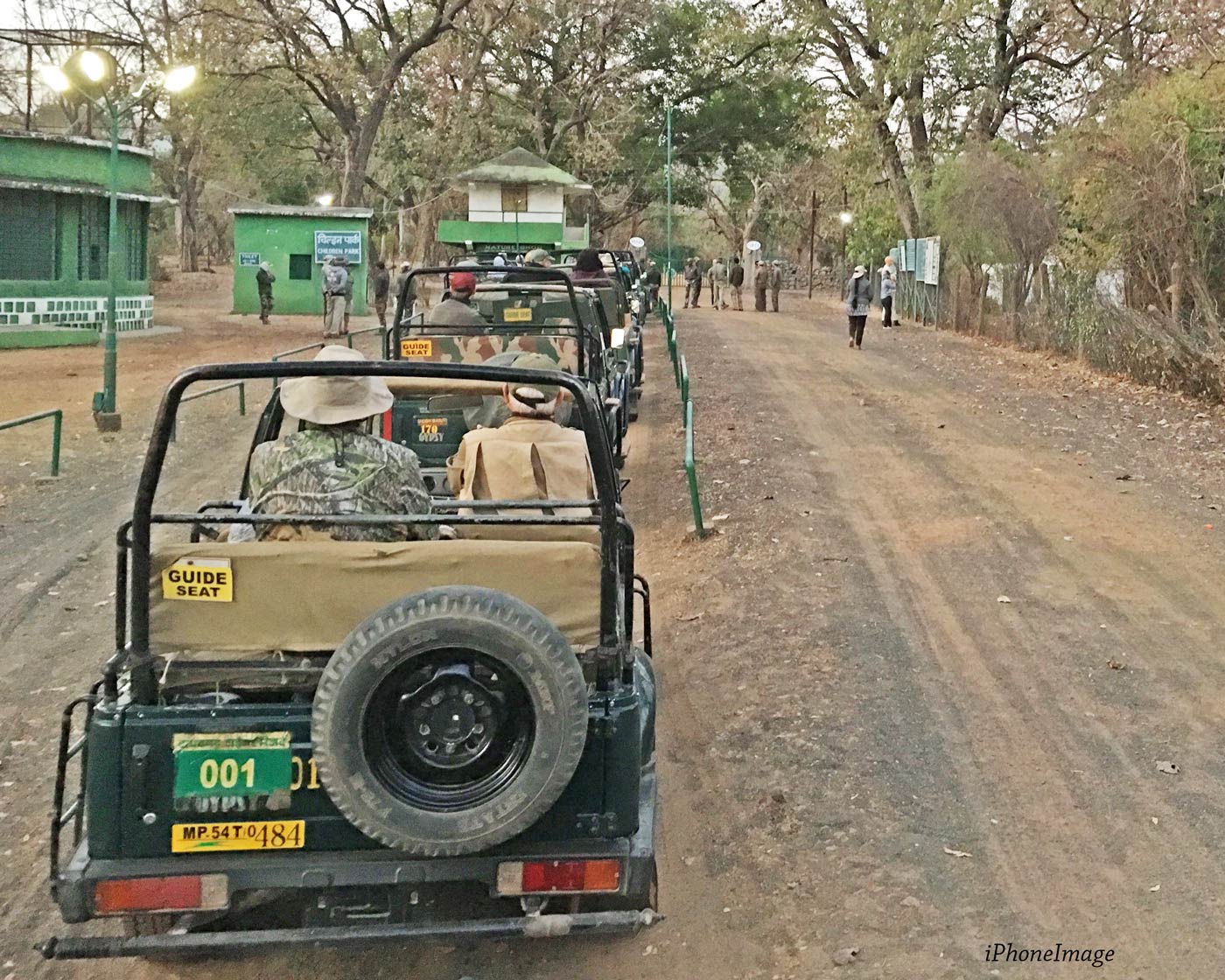
My last visit was in 2015 and things are changing rapidly. Back then about 95% of visitors were
westerners, by looking at the lines of Gypsies waiting to enter the park; my
estimate is that 70% are locals now; there may be seasonal variations but I was
here at the same time in previous years.
Fourteen vehicles per day per park entry gate were allowed in the past;
now there are 20. More tourists, more demand, more money. India is a very
bureaucratic country and every day during each entry to the park, there is a
protocol to repeat.

Previously there was only one waiting line at the gates where the passports/tickets were checked and the escort ranger assigned. Now, one must go to a separate office to get the ranger, then drive to the gate and wait again for the paperwork to be processed. There are different trails at the different gates to the park, and these are labeled a, b, c, d, etc. When a particular vehicle gets its entry paperwork, a trail is assigned…and if you are lucky you may get for example trail c assigned every time; unless one protest that may not ensure a change. I do not believe it is intentionally but it happens. Another rule, that if you are in a group, each person is specifically assigned by name to a vehicle for the length of the visit, and not allowed to change unless one pays a charge of $50.
Now during the middle of the game drive, the drivers are forced to
check at a pre-determined hour at what is called the Rest Area. The drivers had to have their papers signed
to prove compliance with the rules. At
the site entrepreneurs have established shops where one can get souvenirs, food
and drinks, and a latrine stop for which one is charged 5 rupees. If you are a driver or a guide, you just walk
behind the tarpaulin enclosed facilities and do your business. This check stop takes from the drive since no
matter where in the park you are, one have to drive there and then there is a
15-20 minutes of idling time, once in the morning and again in the afternoon. In the olden days, one just got out of the
Gypsy and took care of the call of nature while having the thrill of been eaten
by a tiger. The Ecotourism excuse for this rule is that the human scent
disturbed the animals.

Other recent change is of allowing elephant ride rentals by
the hour for about $30/rider, in the past, the elephants could only be rented
by the day for $350. It appears that the
management was not getting enough day rentals so the change to the hourly
rental was implemented this year, a good business decision; but not for the
elephants, now they have to work harder.
In the second image below, 6 clients boarding the elephant…times $30 it comes
to $180/hour profit and there was a line of waiting costumers. One advantage of
riding an elephant is that you are assured of tiger sightings--- no excuse not to
get great shots. Transfers from the Gypsies to the elephants are made at
prescribed locations within the park depending as to where the tigers are.


Tiger sightings are not as common as they used to be; this is due to a new policy that no iPhones are allowed in the park. In the past, when a tiger was sighted, the guides were notified and a rush of vehicles to the sighting began, the trails became a racetrack to get to the tiger, it was dangerous. During a previous visit, my companion was thrown out of the vehicle and I did not even notice, when I turned, he was not there and looking back, he was in the side of the road dusting his hat but fortunately, only his ego was hurt. This was a good decision in the part of the park management. Tiger sightings are random one may go a whole day and see nothing. Other times; we had a day when we saw 12 tigers that included a family of four. The old female tiger called “One-Eyed” that I had photographed during previous visits, died in 2015; like losing a friend.


There is always a thrill to see a tiger but it does not mean that you will get a photograph; it is not easy since they are mostly moving inside the forest and come in the open when crossing a road or drinking water. Sometimes they rest in the middle of the road. One of my dream shots is that of a tiger running in the water…it happened this time but I missed it…upon the advice of the “guide” we left a tiger that was sleeping near a waterhole. The expert stated that the tiger will not move for 2-3 hours and we could get back later…less than five minutes after we left, the tiger took his run across the water. Never trust the wisdom of an expert. The image below shows a tiger scenting a tree.


The spotted deer are the most numerous in the park along with the languor monkeys. As a consequence one while waits for the appearance of the tiger, one pass the time photographing whatever comes alone. I caught one standing in two legs reaching the leaves from a tree (I had seen this behavior among the white-tailed deer here in Virginia too). It appears that the deer competed by jumping a water stream, One jumped after the other, some made it to the other side but must missed and got wet. This was not an isolated event; it happened at the same time every day I was there. So guess how many shots of wet spotted deer I have? I will continue this blog as a Part 2 soon.


