Saturday, November 19, 2011

The Birds of the Pantanal


So many photos, so little time to blog. From my recent blogs, you can see that the trip to Pantanal in Brazil, has been one of the most productive this year. Birds have been my favorite animals and as a result, I came back with thousands of bird images so here are a few ones. The Black-fronted nun bird above is a new species for me, as most others in this blog except for the Ringed Kingfisher.  This bird looks mostly black but if hit by the light at a certain angle it appears blue.


I have seen many herons but the Capped Heron above, is the most beautiful of them all.  When I first saw it, I had to do a double take; is this bird for real?  I did not see more than 3 of them and they were always alone; most others hang around together and nest in colonies. Those long feathers in the head are really attractive.


The Rufescent Tiger Heron had a peculiar behavior.  It is holding a catfish with a little stick and walking away from sight.  A "bird using a tool."  It shows that we humans are not the only ones.   The type of catfish the bird is carrying has very sharp fin spines.  While the fish is alive, the fins are erected and it is impossible for the bird to swallow it, so the bird waits until it dies and the spines are relaxed parallel to the body.  I saw a Ring Kingfisher with the same species of catbird; it was holding it by the tail hit and slamming it against a branch until dead, and only then proceeded to swallow it whole.


There are 5 species of kingfishers in the Pantanal, I photographed all of them but for brevity, I only loaded in order of appearance the Amazon Kingfisher, the Green Kingfisher and the Ringed Kingfisher which is the largest and most abundant.  Most kingfishers are shy and difficult to approach, but here, you could even grab them from the branches, they appear to be obliviuos to humans.  Imagine, being ignored by a bird, the ultimate insult.


There are many species of flying predators in the Pantanal but the Great Black Hawk and the Savannah Hawk were the most abundant.  They mostly feed in smaller birds but sometimes they also go after fish. 


Birds come in a variety of colors but the Jacama and the Vermillion Flycatcher are really flying jewels.  When I first saw the Jacama, I though it was another species of kingfisher because it looks similar and nest in holes in the banks of the river.  But after observing it for a while, I noticed that it seats in a tree branch, and then fly-off capture insects and returns to the same perch.  The Vermillion Flycatcher,  as the name implies, is right truly intense red; what a difference in body shape, and coloration between these two birds.  Also consider that both feed in insects that the catch while flying; why the difference in beak length?


Two birds that owe their names to their bill peculiarities are the Smooth-billed Ani and the Yellow-billed gulls.  The Ani needs such a heavy bill to be able to cracks seeds and I assume that the gull's yellow bill has something to do with breeding. In the bottom image above you can see an immature gull asking for food.


And finally, we get to the Sun Grebe, another unusually colored bird that I have never seen bird. This bird feeding behavior is unusual for a grebe, instead of diving in the pursuit of fish, it swam along the shore line picking up insects from the vegetation. I am sure that the sun grebe also dives for fish but I did not witness it.

Friday, September 30, 2011

The Jaguars of Pantanal II


One morning I ran into a collared jaguar panting with saliva dripping from the mouth.  It appeared stressed by the tracking collar.  These collars carry telemetry devices to track the animal movements; some are able to monitor physiological and environmental parameters too. While watching the jaguar, the guide told me that 3 collared jaguars were recently found dead. The rumor was that the lost of these endangered cats was caused for having the collars to tight.


There appears to be various groups involved in collaring jaguars in the Pantanal; but it was not clear if the responsible culprits were private individuals, environmental private groups or government agencies.  A wildlife management friend confirmed that it is critical how these collars are fitted to the animals, if too tight, they may cause problems.  And these are not just limited to physiological burdens but may also induce behavioral changes.  

The use of tracking collars has become widespread since the early 1990's to study animal migration patterns, territorial boundaries, etc.  As the collars became more sophisticated, they are capable of recording physiological as well as environmental parameters.  The   information is collected in the collar or transmitted by radio signals to cell phones or via satellites.  Originally the tracking devices were equipped only with a VHF beacon and the trackers have to follow the collared subjects in the field with an antenna to determine their whereabouts.  Older models also used to collect the information in the collar itself and to retrieve the data, the animal has to be recaptured again. Newer collars can be programmed to drop-off from the animal and the data analyzed.  But the trend is towards collars that transmit the data and that can be reprogrammed by telemetry.


Does the fitting of tracking collars have an impact in the involuntary user?  There was a study conducted of Florida panthers in the Everglades between 1978-79; of the 65 deaths recorded, 41 were radio collared. Of the collared panthers that died, it was determined that 33% died in fights with other panthers (is the collared jaguar impaired by the collar during the fight?).  Another factor affecting the mortality of animals is during their capture to be fitted with collars, usually with tranquilizing dart guns.  If the anesthetic dose is not properly calculated, it may result in the animal death.  Also the handling of the anesthetized animal while being collared, measured, weighted, and biological sampled, may result in additional injuries. 


Does the practice of using collars for wildlife management worth the loss of animals?    Are those involved in these practices professionally trained to safely conduct such endeavors? Are the wildlife populations benefiting from this practice?  What is the data used for?  Are there funds available to improve of the species habitat based in the data obtained if analyzed?  I have not formed an opinion as to benefits of this practice.  But is surely annoys me when I encounter collared animals in the wild.  Will there be any wilderness left?

Saturday, September 3, 2011

The Jaguars of Pantanal, Brazil

 Just returned from one of my "one in a lifetime" adventures; I was dreaming at least to photograph just one jaguar.  It was surpassed, in 8 days sighted 23 of these cats.  My first encounter was with a jaguar resting on bluff next to the Cuiaba River hidden by the underbrush (above).
 The next day, I saw a jaguar shaking a small tree and could not figure why? Then, I realized that it was knocking young flightless birds from their nests.  These were baby limpkins, and as they dropped from the tree, fell into the water and were able to swim ashore.  The leopard walked down to the river's edge, picked one chick, eat it and so on.   


 After feasting the jaguar walked up the bluff and along the shore to a sandy beach to get a drink, it paused, looked around and continued drinking.  Then went to take a siesta.
On another occasion, I witnessed a fight between two males; they appeared to be siblings just playing.  But the next day in the same area, there were 4 males and one female.  It became clear to me that the fight that I saw the previous day was not a game; they were fighting for the privilege to visit with the girl.  By this time, the scores were settled and prevailing male was mating with the "she jaguar".

One day I followed a jaguar along the shores of the river from a boat while he hunted for capybaras.  These giant rodents are very alert and can swim and dive swiftly.  He saw a family of capybaras with a young one.  As he paused, somehow the male capybara became aware of his presence, gave a sharp call to which the mom and baby responded by jumping from about 20 feet in height into the river.  The male followed soon after.

Sunday, August 7, 2011

Yellowstone Park continued...


Spring time brings courtships and new life to Yellowstone.  I had the opportunity to observe a pair of Barrow's goldeneyes going through their romance.  They got so close to me that in my opinion, they were obsessed with their love making that they did not see me.  Part of the ritual was for the male to take short runs and then approach the gal, accompanied by lots of head movements.

After mating, the female climbed into a log and preened herself insuring that all feathers were in place and flew to a large pine tree where it appears that a nest was being built.

A mama badger was busy feeding her family of 3 young ones.  I spent time with the family until finally; I was able to capture the Mom bringing a Uinta ground squirrel to the den.  Prey was not easy to catch because the mother will be gone at times for 3-4 hours before returning, and some times with no prey.  This was my first time ever seen badgers in the field.

Brown bears are easily seen in the Park but at times 1 or 2 days go by without seen one.  But other days many are sighted at close range.  On one day I saw 12 brown bears.  Grizzly bears are also seen but I was not able to get a good image of one.  In the spring time is common baby bears.  Whenever bears are seen, lots of people arrive along with the park rangers; these are preventing the tourists for getting close to the bears and to get the traffic moving.


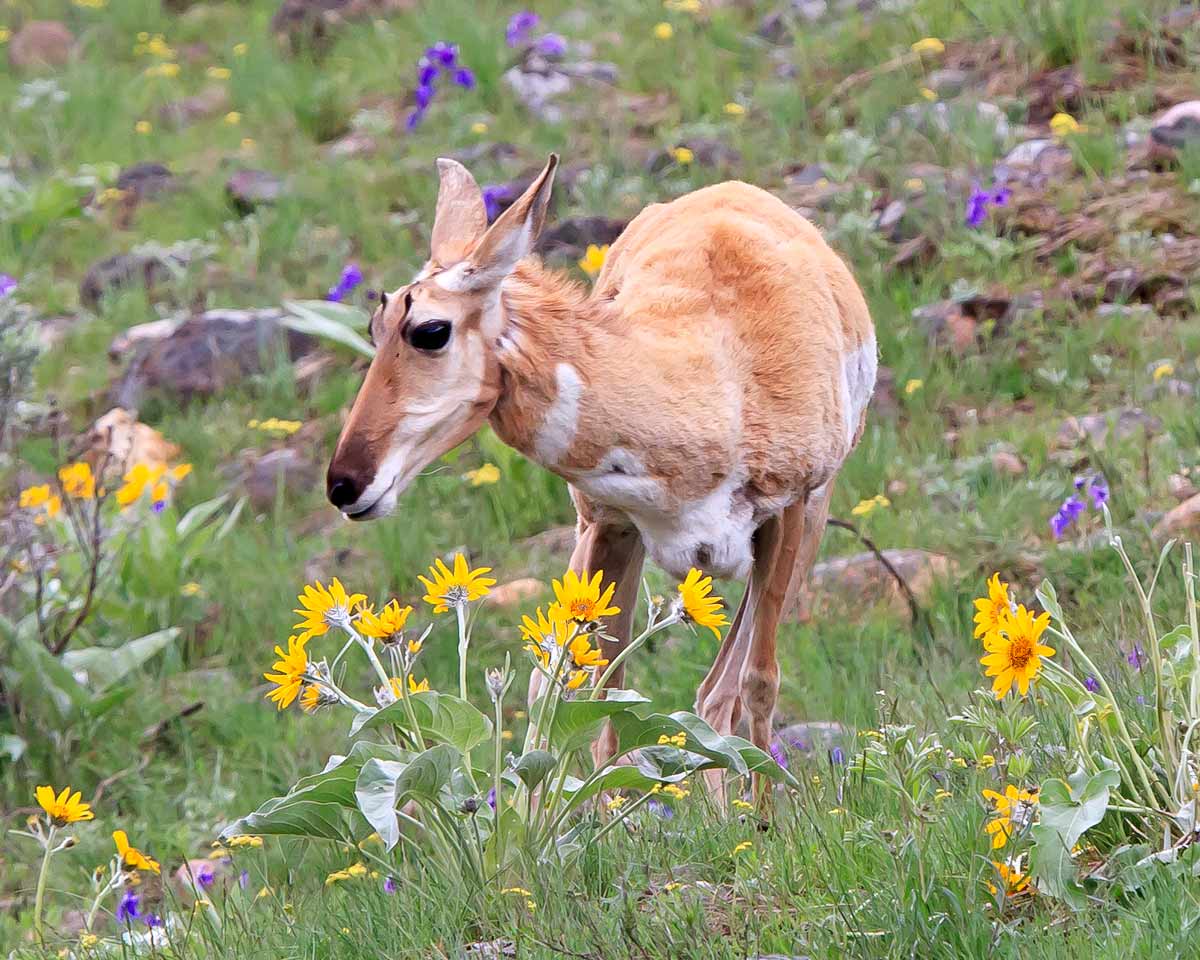
Elks and buffaloes are very common as well as pronghorn antelopes.  Most the mothers are feeding the young ones.  These, like young children are running around, jumping and tasting the grasses, the joy of new life.

Late one evening I ran into a female moose with cute yellow calf.  She was looking for a safe place for the calf to bed for the night.  She was at the edge of the forest looking along the tall grass, when she found the right spot, the calf when down.  I am told that the calf will not leave the spot until sunrise.

Saturday, July 30, 2011

Wyoming's Serengeti


Yellowstone has many similarities to the Serengeti/Masai Mara ecosystems due to the large concentration of ungulates and their migrations patterns.  Although the number of migrants in Yellowstone is smaller, it is still a sight to enjoy.  The rainy and dry seasons, drive the migrations in East Africa; while in Yellowstone, the temperature changes between winter and summer are the forces that cause the migrations.  Above we have some buffaloes jumping a tributary of the Yellowstone River; you will see wildebeests jumping the Mara River in Kenya but in larger numbers.  


Due to the large numbers of visitors in both Yellowstone and East Africa, ways of controlling their impact in the ecosystems are very similar.  In Yellowstone, vehicular traffic is limited to the roads; this is a practice adopted in the recent past in the Seregenti, and to a more limited extends in the Masai Mara.  Off the road driving is not longer the rule in Africa.  Another phenomenon is the concentration of people/vehicles where an unusual animal sight is found or where a kill have occurred.


The lions of Yellowstone are the wolves and their cousins the coyotes.  There are also  bears as well as smaller ones as the badgers.  The wolves were recently reintroduced in the park and their presence has attracted a loyal group of trackers that spent endless hours recording their behavior.


I had visited this park in all seasons except for the winter; I do not handle cold temperatures well. Spring is probably the most exciting because of all the new life as well as the flowers abundantly present.  Of course, fall is also colorful because of the changes in foliage and the elks rutting season.  Summer…it is for the tourists.  Yellowstone is the Premier Park in the USA; there are animals, unusual landscapes to include geysers and waterfalls.  A place of wonders.  


Sunday, July 17, 2011

Camas National Wildlife Refuge


Driving north in Idaho I-15 towards the refuge, I saw this large six-pack that I could not pass.  Unfortunately they were silos camouflaged as beer cans; a refreshing sight after driving for hours.  This area of Idaho is mostly agricultural and yes, they do grow potatoes there.


Arriving late in the afternoon at the Refuge, it did not look too impressive, and as much of the West bodies of water this spring it was flooded.  It was established in 1937 as a breeding ground for waterfowl and as a resting stop for migrating birds.  My first sighting was the yellow-headed blackbirds, a new species for me.  They were all over the cat tail reeds displaying and raising a cacophony of sounds.  It was the breeding season and the males were trying to impress the girls and defending their territories.  In their behavior, they are very similar to their cousins the red-winged blackbirds.


The waterfowl were courting and some were already building their nests.  Others such as the coots had already hatched their chicks and were actively feeding them.  The cinnamon teals above, were also a new species for me, the males color could have not been better described; just the same color as the condiment.  The females, more practical, had a plumage that help them to blend with the reeds where them nest.

Another surprise for me were the male ruddy ducks, I had never seen them before in their breeding colors with those strong red feathers and the fabulous blue bills.  They are really funny to watch they pump their heads up and down when attracting the females.  Another peculiarity is that they make the water bubble in front of their chests by making a very low frequency sound (I assume since I could not hear any noise).   I have seen the similar bubbling of water done by alligators.  These small ducks are very aggressive and will not permit another male of any species to even look at their partner.   Jealous birds they are, wonder why?  The females are just plain Jane's, but then, I have no ruddy duck eyes.

The long billed wren was also very active settling territorial disputes and chanting to the world "do not trespass.  This bird I photographed earlier in the year in the east coast while involved in the same behavior.  It a fetish little bird.

Harriers were also very active flying over the marshes looking for prey.  These were already nesting among the reeds.  One evening, a male have caught a rodent (above) and flew towards its nest; on approach the female flew up from the nest and let go of the furry creature that was promptly captured in mid-air by the female.
Visiting Camas was very rewarding; at one time it was a farming area.  Some of the ruins of the original settlers are still visible, against the chocolate flood waters and the blue skies make a good departure image.